
The Laykyun Sekkya is a colossal standing statue of Gautama Buddha, measuring 116 meters (381 feet) in height including its throne, located in the village of Khatakan Taung near Monywa in Myanmar’s Sagaing Region. Completed in 2008 after construction began in 1996, it forms the centerpiece of the Maha Bodhi Ta Htaung temple complex, which also features a reclining Buddha statue measuring 101 meters long, the second-largest in Myanmar, and a sitting Buddha statue completed in 2022. The statue’s interior spans 31 floors adorned with murals and sculptures depicting Buddhist cosmology, serving as both a pilgrimage site and a symbol of spiritual devotion.
Initiated in 1960 by the monk Ven. Nārada as part of a broader effort to create monumental representations of Buddhist teachings, the Laykyun Sekkya reflects Myanmar’s post-independence emphasis on religious and national identity. At the time of its completion, it briefly held the title of the world’s tallest statue before being surpassed by China’s Spring Temple Buddha, and as of 2025 it ranks as the third-tallest statue globally. The structure’s design, with the Buddha in a serene standing pose clad in golden robes, draws visitors for its architectural scale and the viewing galleries that allow ascent to higher levels for panoramic views. The statue is constructed primarily from reinforced concrete, providing structural integrity for its immense scale. The exterior features gilded accents, including gold plating, to evoke traditional Burmese Buddhist aesthetics. As a key cultural landmark, it underscores the role of monumental art in promoting enlightenment and compassion within Theravada Buddhism.
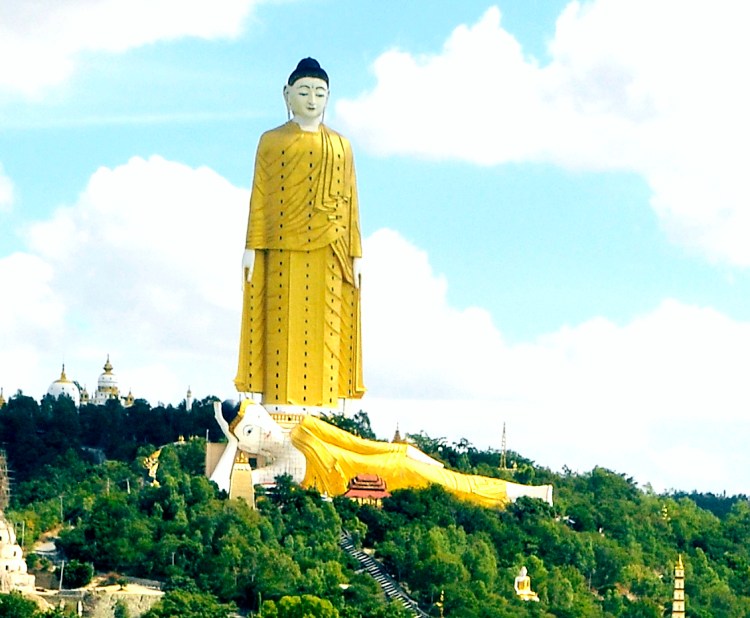
Rooted in Burmese Theravada style, the statue incorporates intricate carvings of lotus flowers and narrative scenes from the Buddha’s life, illustrating core teachings and cosmological elements. These motifs evoke purity through the lotus and the path of enlightenment through biographical vignettes, blending artistic expression with doctrinal narrative.
The overall symbolism centers on enlightenment and protection, portraying the Buddha as a beacon guiding devotees toward liberation. The elevated throne represents the ascent to nirvana, distancing the figure from mundane illusions, while surrounding Bodhi tree motifs in the complex evoke the sacred tree of awakening at Bodh Gaya, reinforcing connections to the historical site of the Buddha’s realization.
The statue is rendered in vibrant colors and gold plating to radiate spiritual luminosity and divine grace. The statue incorporates slight stylization in its proportions and serene facial features for enhanced visibility from afar, diverging from the more rigid, angular forms seen in some Indian-derived Asian Buddha representations while preserving the fluid elegance of Burmese aesthetics.
As a key pilgrimage destination, Laykyun Sekkya attracts domestic monks, lay Buddhists, and international visitors, integrating into Sagaing Region’s broader “Buddhist hill” circuit alongside nearby pagodas like those in the Monywa area, where pilgrims combine visits for enhanced spiritual merit. The site’s grove of thousands of Bodhi trees, each sheltering a Buddha statue, evokes the sacred site of the Buddha’s enlightenment at Bodh Gaya, encouraging contemplative walks and prostrations that embody Burmese Theravada practices of veneration and mindfulness.
 BMV Digest