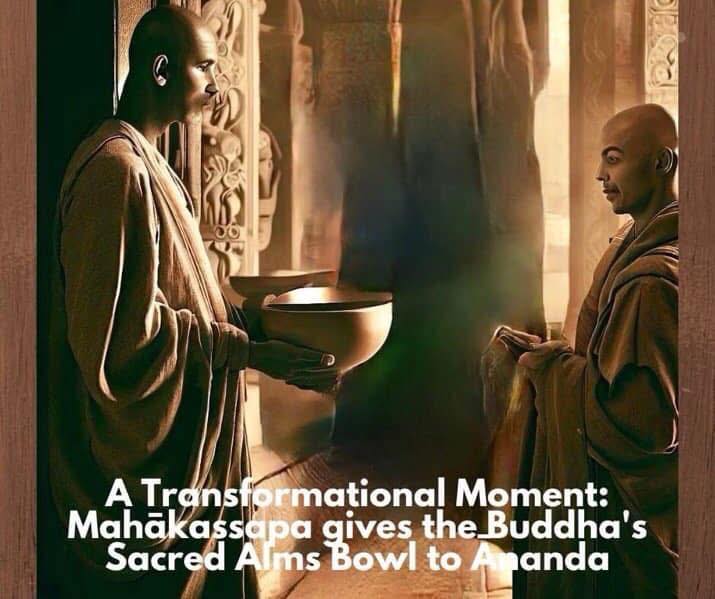
During their times as disciples and up to the aftermath of the Buddha’s passing, the relationship between Mahākassapa and Ānanda, two towering figures in the early Sangha, remained fractious.
Mahākassapa, weathered by the winds of countless years spent in austere contemplation, clung tenaciously to the ancient vows he had embraced in his youth. His existence was one of simplicity and rigorous discipline. He believed that the path to enlightenment was paved with ascetic stones. Even in his old age, he declined the invitation of the Buddha to reside with the core leadership. But he was the embodiment of unwavering devotion to the Buddha’s teachings.
In sharp contrast stood Ānanda, the Buddha’s “Agra Upasthayaka”, chief assistant, and “Dhamma Bhandagarika”, the repository of Dhamma. Unlike Mahākassapa, Ānanda was an epitome of tolerance, compassion, and boundless understanding. According to the Gotami Sutta (With Gotami), his benevolence extended not only to the monks but also to the nuns, laymen, and laywomen – the four-fold Assembly, as it was called. It was Ānanda who repeatedly and fearlessly advocated and supported the founding of the Bhikkhunī Sangha.
The disparities between Ānanda and Mahākassapa clashed at times. The latter was critical about Ānanda’s companionship with young, undisciplined monks, whose senses were untamed, whose appetite knew no moderation, and whose sleep was excessive.
To Mahākassapa, it seemed as though Ānanda tread recklessly, trampling the fragile faith of families. In his unyielding rigidity, Mahākassapa urged Ānanda to take tougher action.
But Ānanda, ever the bridge between discord and harmony, was not deterred by Mahākassapa’s stern words. He continued his mission. And he once invited Mahākassapa himself to address the bhikkhunis in the “nuns’ quarters”. The results were as turbulent as a monsoon downpour; Mahākassapa’s words were met with challenging comments from a bhikkhuni, named Thullatissā .
Reacting to these comments, Mahakassapa issue a warning, as reported in the discourse on “The Nuns’ Quarters”:
“Hold on, Venerable Ānanda! Don’t make the Saṅgha investigate you further!
“Āgamehi tvaṁ, āvuso ānanda, mā te saṅgho uttari upaparikkhi.”
However, Ānanda was undeterred. He recognized that the preservation and propagation of the Dhamma required radical change and understanding, even in the face of staunch opposition.
In Theragatha (Sayings of the Elders) 1046, he openly admits that the passing of the Buddha had shaken him to his core, the fear and uncertainty palpable as he recalled those moments:
“Then there was terror, and the hair stood up, when he, the all-accomplished one, the Buddha, passed away.”
As he stood in front of the packed pavilion at the First Buddhist Council, Ānanda felt the weight of history pressing down upon him. His knowledge of the Dhamma, his character, and even his conduct was scrutinized beneath the unrelenting gaze of the assembly. Yet, with the grace of a masterful diplomat, he navigated the treacherous waters of contention, skilfully ensuring the preservation of the Buddha Dhamma for generations to come.
In the wake of the First Council, respect for Mahākassapa grew even more.
He became the de facto leader of the Sangha, the anchor upon which the community relied for guidance and stability.
However, as the sands of time slipped through Mahākassapa’s grasp, and the embers of his life flickered, he experienced a profound transformation.
The austere hermit, the strict disciplinarian, recognized the virtue of tolerance, compassion, and understanding of Ānanda’s character.
In a gesture as profound as the deepest act of mindfulness, Mahākassapa passed on the Buddha’s alms bowl to Ānanda. It was a symbolic bequest, a testament to the preservation of the Dhamma.
In that moment, Mahākassapa, the paragon of asceticism, acknowledged Ānanda as his spiritual successor, the torchbearer of the tradition.
Ānanda, who had walked the path of compassion and tolerance, had won the respect and trust of the sternest of mentors.
This extraordinary gesture, born from the crucible of conflicting lifestyles and tempered by the fire of their dedication to the Dhamma, speaks to the heart of Buddhism. It demonstrated that even amidst differences as vivid as night and day, unity could be achieved for the greater good.
In their final act together, Mahākassapa and Ānanda embodied the Buddha’s teachings, proving that the path to enlightenment was not confined to a single road but was a vast, inter-connected web, where compassion and austerity, tolerance, and discipline, could co-exist in harmonious balance.
Sources:
Maha Kassapa Father of the Sangha by Hellmuth Hecker revised and enlarged translation from German by Nyanaponika Thero
https://accesstoinsight.org/lib/authors/hecker/wheel345.html
Ānanda The Guardian of the Dhamma by Hellmuth Hecker
https://www.accesstoinsight.org/…/hecker/wheel273.html
 BMV Digest