By Paolo Coluzzi
Continuing Paolo Coluzzi’s backpacking journey through several countries in Asia. This time, he visited South Korea, also known as the ‘Land of the Morning Calm’.
South Korea
From the point of view of Buddhism, South Korea is indeed a curious place. Until the end of the Second World War nearly all South Koreans were Buddhist, whereas now, thanks to intense proselytizing and the prestige that Christianity holds – in part due to its status as the predominant religion in the West – Christianity has become the first religion of Korea, with the rich and the urban tending towards it, whilst people in small towns and the countryside remain largely Buddhist. However, Buddhism is as responsible as Christianity is for this state of affairs: as in many other Buddhist countries, the teaching of Buddhism – including mindfulness and other meditation techniques – was relegated to monks and scholars, when in reality most of the population was unfamiliar with its deep philosophy and could not but merely follow rituals. In spite of this, even though today there are more churches than temples here, extraordinary Buddhist sites – some very old – are to be found all over the country. Foremost amongst them is the Temple of Haeinsa on Mount Gayasan (a UNESCO World Heritage Site), which is home to the Tripitaka Koreana, the world’s most complete corpus of Buddhist doctrinal texts engraved on more than 80,000 woodblocks in the 13th century.
The Tripitaka Koreana woodblocks and their depositories (Janggyeong Panjeon) have been designated National Treasures, and the former was inscribed on UNESCO’s Memory of the World Register in 2007.
I, personally, have only visited Seoul thus far, and focus the first part of this article therefore on the Bongeunsa Temple in the capital.
Bongeunsa Temple (August 2014)
In mid-August, I set out for the Far East. I’ve decided to take another short holiday to go and see my friend and former colleague Jisun and have a peek of Seoul, the capital that, over a couple of dozen years, has gone from being a developing country to one of the strongest economies in Asia. And this despite an unfortunate history of Japanese invasions and colonialism and of a civil war with the classic intervention of the United States, a country that always seems to be ready to go to war in the name of defending ‘freedom’ (particularly economic freedom, the more so if it can personally benefit from it).
Curious about Korea for a long time, I both wanted to know more about it and yet, at the same time, did not feel quite drawn towards it, as I perceived it in rather a negative light on account of the impressions left on me by TV programmes, articles, and stories told by both Koreans and outside observers. A hyper-technological and consumerist society of lonely and frustrated people; a population that was rapidly abandoning many of the things that bound it to its past, among them its traditional religion, Buddhism, renounced by many a Korean to embrace the one arrived from the West (and more precisely from the United States), Christianity; a supposedly hedonistic people, a large percentage of whose young and not-so-young members submit to plastic surgery to become ‘more alluring’, which often means to look more Western.
But the salutary side to travel, we know, is that on balance it helps one overcome one’s prejudices. Every country in the world has its strengths, often best grasped through direct experience. And so it is with South Korea: I do encounter the consumerist and Westernised country alright, but one humanised by its accommodating citizenry, a nation rich in history and traditions.
My airplane leaves at nine in the morning, and a little over six hours later I land at Incheon International Airport, where Jisun is waiting for me.
The following morning, we have a slow breakfast and then start our exploration of the city. We spend the day moseying around the city centre: first the Insadong neighbourhood, with its small restaurants, tea-houses, and bric-a-brac and souvenir shops; then the traditional houses in Changdeok and the Changdeokgung Palace with its landscaped gardens. We finish the day with a long walk in the modern centre south of Gyeongbokgung Palace, and a Korean dinner in the busy shopping neighbourhood of Myeongdong. From Jisun’s house to the city centre we take the underground, an immense network of nineteen lines with as many as 311 stations, which makes it one of the largest in the world (ranking fourth for the number of stations). One can only wonder what it would be like to move around this city of eleven million without that network.
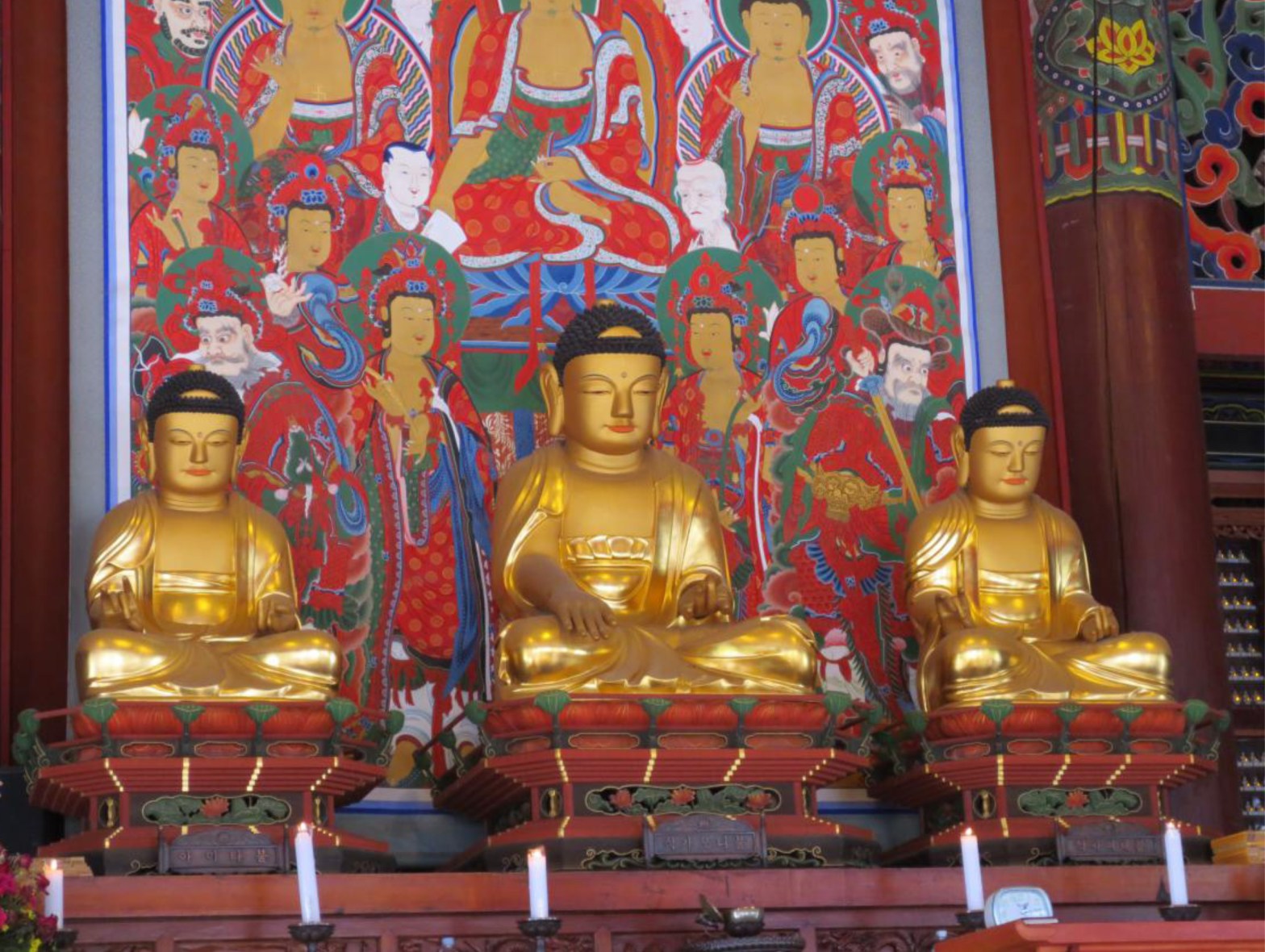
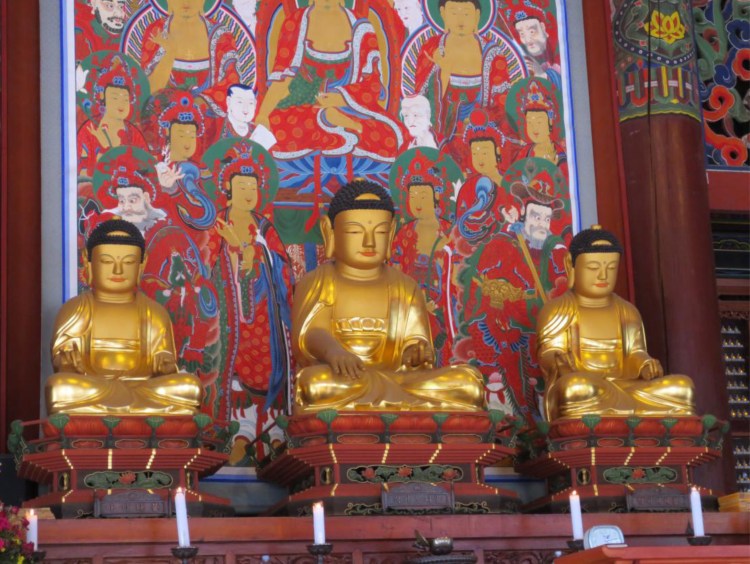
The following morning, Sunday, Jisun goes to Mass (she is Christian) and I take advantage of this to go and visit the most important Buddhist temple in Seoul: the Bongeunsa. It is an irony to think that I come from an historically Catholic country and go to a Buddhist temple; whereas my friend goes to a church, a place of worship that was rather rare in Korea before World War Two (in 1945, Christians in Korea made up about 2 per cent of the population; now they are about a third of the entire Korean population, having outstripped the number of Buddhists).
Bongeunsa was originally built in 794, in a style not much different from Japanese temples. Both the main hall and the other pavilions that make up the temple are filled with people reciting sutras or meditating on cushions laid out on the wooden floors before the statues of the Buddha. The rear part of the enclosure leans against a green hill (following fengshui rules, one supposes), to one side of which stands a large 23-metre-high statue of the Maitreya Buddha. Next to the entrance gate is a small shop selling books and other Buddhist articles, and alongside it a tourist counter with friendly volunteers who speak good English. One cannot but admire the passion they put into attempting to ‘revitalise’ Buddhism in Korea, which has lost so much ground over the last fifty years. However, I personally believe the spread of Christianity in South Korea has also proven salubrious for Buddhism. The latter has had to shake off the complacency that came of its being the dominant religion. Buddhism here has had to reorganise itself, become more active, open up to everybody, transform into a religion and philosophy of life that is no longer the exclusive preserve of monks (as in the past) but there for lay people as well. That may well be the only way for it to recover ground with respect to Christianity, or to the even more widespread influence of materialism.
We spend the rest of the afternoon visiting the Myogaksa, a much more recent Buddhist temple (built in 1930), and walking about Insadong again, to finish off the day with an Italian dinner (cooked by me) in Jisun’s place.
The following day, after breakfast, I take the underground to get to the airport, and at 4.25 that afternoon my plane leaves for Kuala Lumpur. Brief but intense, this my first visit to Korea has shown me what may be a case of revitalisation of Buddhism in Buddhist Asia.
About the Writer :
Paolo Coluzzi was an Associate Professor at the University of Malaya, KL. At present, he is teaching Italian and Tai Chi in Granada, Spain, where he moved at the end of 2024. He first became interested in Buddhism at the age of 17. It is a fascination that has deepened over the years, thanks to personal practice and contact with the many monks and Dharma experts he has encountered during his long stay in Asia.
 BMV Digest