(Case Studies in Dhammic Diplomacy)
By Mr Don de Silva (Pali Canon FB page)
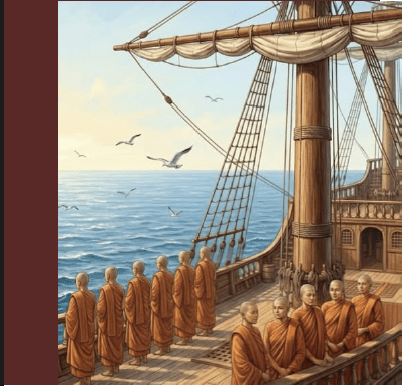
This is the account of two sea journeys that reshaped Buddhist history far beyond the shores of Sri Lanka — the initiatives of Bhikkhunī Devasārā (Tiěsàluó 鐵薩羅) and her companions, whose arrival in China laid the foundations for the fully ordained Bhikkhunī Saṅgha on Chinese soil.
It is essential to recognise the deliberate effort, careful planning, and substantial resources that such undertakings required. As with the International missions of Emperor Aśoka, the arrivals of Mahinda Thera and Sanghamitta Mahātheri, the Dhamma Envoy of the Aśokan Empire to Tambapaņņi (the ancient name for Sri Lanka), nothing about these voyages was accidental. They represent coordinated initiatives involving very careful and strategic planning, royal patronage, monastic leadership, maritime expertise, and unwavering commitment to the Buddha Dhamma.
Every Asókan international mission and the Sri Lankan Bhikkhuni initiatives — represent years of planning, coordination, and precise execution — stand as exemplary case studies for modern diplomatic training programmes. They demonstrate how states, Dhammic institutions, and maritime networks collaborated across cultures and vast distances — in harmony —to achieve outcomes of lasting civilisational importance.
The First Arrival: The Pioneer Group
The earliest documented Sri Lankan Bhikkhunīs to reach China arrived in 428 CE, recorded in Biographies of Buddhist Nuns:
“In the sixth year of Yuan-jia (428), a foreign ship owner named Nandi travelled from the Land of the Lion (Sri Lanka) with some nuns, who arrived in the capital of Song and stayed at Jing-fu Nunnery.” — Li Rongxi
They remained at Jing-fu Nunnery, learned Chinese, and familiarised themselves with Chinese monastic life. Just like major diplomatic efforts today, this appears to be to a reconnaissance mission, quietly preparing the ground for a much larger endeavour.
The Second Arrival: 433 CE — Devasārā Theri and the Formal Mission
The decisive mission arrived five years later, in 433 CE. The same text states:
“In the tenth year (433) the ship owner Nandi came again with eleven nuns, Devasārā and others, from the Land of the Lion.” — Li Rongxi
How did Devasārā Theri and Sri Lankan nuns first hear of China?
By the early 5th century, Sri Lanka and China were already in steady contact.
The Chinese pilgrim Faxian had lived in Sri Lanka from 411–412 CE, residing in the Abhayagiri Monastery, where he studied Vinaya and obtained manuscripts for translation. He returned to China and settled in Jiankang (Nanjing), becoming a respected translator and advisor. His presence alone was enough to keep Sri Lanka in the Chinese monastic imagination.
Chinese texts confirm this link:
In 428 CE, King Mahanāma of Sri Lanka sent a diplomatic mission to China, offering a model of the Shrine of the Tooth Relic to the emperor of the Liu Song dynasty.
Where could the invitation have come from?
While no text contains a formal invitation letter, the Chinese Buddhist Texts strongly suggest:
• Faxian’s direct encouragement
• a request from Chinese monastics seeking full dual ordination
• a favourable diplomatic ties and political environment between King Mahanāma and the Liu Song emperor
The Voyage: How Long Would the Journey Have Taken?
Venerable Faxian records that his voyage from Tāmalitti (Tamralipti) to Sri Lanka, aided by the favourable dry monsoon of early winter, took fourteen days and nights.
This provides a reliable benchmark for the speed of a well-built merchant vessel: 3.9–4.5 km/h (2.1–2.4 knots).
Using this, and surmising that Nandi, the ship captain, may have followed the established Southeast Asian maritime corridor, each of the two Sri Lankan Bhikkhunī missions would likely have taken more than eight to eleven weeks at sea. We have to also take into account stops for rest and replenishing provisions for the Bhikkhuni Sangha and a larger crew.
A Contrast with Faxian’s Ordeal
Faxian’s return journey stands in stark contrast: he was caught in repeated storms, blown far off course, nearly starved, and forced to land in Java, where he remained stranded for months. He notes more than once that the manuscripts he carried almost perished.
By comparison, the Sri Lankan Bhikkhunīs arrived safely on both missions. The Chinese records mention no storms, shipwrecks, or calamities. The contrast is striking and points to better vessels, careful seasonal timing, or even royal sponsorship supporting their journeys.
Royal Sponsorship?
While no Chinese text explicitly names King Mahanāma as sponsor, the circumstantial evidence is overwhelming:
• The nuns travelled on large Indian Ocean merchant vessels (舶 bo) — journeys impossible without major financial backing.
• King Mahanāma had active diplomatic relations with China in these very years.
• News of Venerable Faxian’s harrowing return ordeal would have spread to the courts of the Chinese and Sri Lankan rulers, and to the shipping world. Extra precautions would have definitely been taken to the security arrangements of the two voyages.
• The Sri Lankan nuns belonged to Abhayagiri, a monastery famous for royal patronage and international engagement. Their missions fulfilled a royal-level diplomatic-religious purpose: completing the Chinese Bhikkhunī lineage.
It is reasonable to recognise the quiet but strategic role of Venerable Faxian in facilitating the conditions that enabled both Sri Lankan Bhikkhunī missions: his presence in Nanjing, his familiarity with diplomatic protocols, and his direct experience of the royal courts of Sri Lanka and China would have made him an invaluable intermediary at a pivotal moment.
Arrival at the Great Port of Nanjing
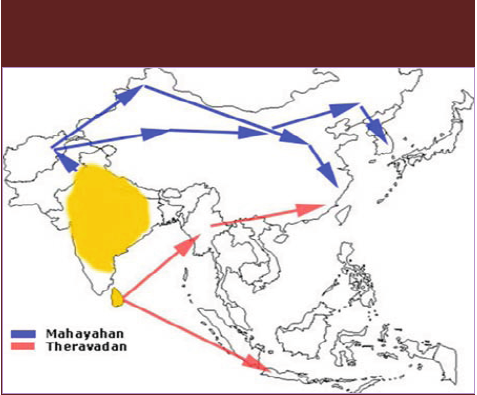
Both missions reached Jiankang (Nanjing) — then the bustling maritime capital of the Southern Dynasties:
• The largest inland port in the world, linked to the East China Sea;
• A cosmopolitan Buddhist centre full of international monks, merchants, translators, and scholars; and
• The destination for both Faxian and Devasārā.
Establishment of the Lineage
With both groups present, Bhikkhuni Devasara and her companions of Sri Lankan nuns performed the higher ordination (Upasampada) for more than 300 Chinese women at the Nan Lin (Southern Forest) Monastery in Nanjing and establishing a lineage that would impact the world.
Unbroken Lineage
The ordination brought by Devasara enabled the continuation of China’s bhikkhuni lineage, has continued to the present day in an unbroken upasampada (ordination) lineage and eventually was transmitted to Taiwan, Korea, and Vietnam. There are now thousands of Taiwanese, Korean, Vietnamese, and Chinese bhikkhunis
Connection to Sanghamitta:
The lineage led by Devasara is considered a continuation of the tradition brought to Sri Lanka by Arahant Bhikkhuni Sanghamitta, the daughter of Emperor Ashoka.
Modern Relevance:
Due to the decline of the bhikkhuni order in Theravada countries in later centuries, the lineage established by Devasara in China has become crucial for the revival of the Bhikkhuni order in modern Theravada nations.
Sources: Edited from The Pali Canon FB Page and Alliance for Bhikkhunis https://present.bhikkhuni.net/2600-year-journey/
 BMV Digest