By Paolo Coluzzi
Continuing Paolo Coluzzi’s backpacking journey through several countries in Asia. This time, he visited Sri Lanka, also known as the ‘Pearl of the Indian Ocean’.
Sri Lanka
Whereas Buddhism all but disappeared from India for various reasons – surviving only in a few places like Assam, Kashmir, Sikkim and Arunachal Pradesh – Sri Lanka not only retained Buddhism, but even ‘exported’ it to other Southeast Asian nations. While the majority of the Sri Lankan population is Buddhist of the Theravada school, there is nevertheless a fairly large Hindu minority, too, as well as groups of Muslims and Christians. Befitting its long history as a Buddhist nation, Sri Lanka is home to several ancient Buddhist monuments, found in many parts of the country, but in a far higher concentration in the old capitals: Kandy, Anuradhapura and Polonnaruwa. It is this last site that struck me the most. Why I took to it I do not know; perhaps because of its relatively small self-contained proportions, or because of its location – nature all around, a vast lake – or perhaps simply because there were not many tourists about.
Polonnaruwa (November 2012)
During the week spanning 12–18 November, there are no classes at UM as it is the mid-semester break. Therefore, tagging on the previous week’s Friday when I have no classes to teach, I have a good ten days at my disposal to set out on a trip. This time, I wish to take advantage of the break to start exploring a part of this continent I have never been to before: South Asia. More precisely, Sri Lanka.
Friday morning at 11, my flight takes off for Colombo. Less than three and a half hours later, having flown over the green island, we land at what in 2012 is still the only international airport in the country, 30 kilometres north of the capital. I’m in South Asia at last! In a nation that is patently less poor than India, a little less densely populated too, and where the dominant religion is not Hinduism but Buddhism. The Tamil community in the north and east is Hindu, and for the larger part of this island’s history the two religions have lived together in concomitance, much more so than in the other Buddhist countries I have visited thus far.
I get out of the airport and head for the free shuttle bus that takes passengers to the nearest coach station. Looking around me from the bus window, my first impression is of having arrived in a country not unlike others I have visited in Southeast Asia: poorer than Malaysia, perhaps closer to several places I’ve seen in Indonesia. The heat is the same as in Malaysia, and the difference that stands out most – besides the statues of the Buddha that one glimpses – is the dusky hue of the people’s skin and the shape of their eyes, which is here more ‘Caucasian’ looking. Even though many are in Western attire, I can also see several multicoloured sarees, bulwark against the incipient westernisation, together with the tasty local food. Once I arrive at the coach station, I don’t have to wait long to catch the coach for Kandy, my first destination. During the three-and-a-half-hour-long journey, two things strike me most: the intense green of the landscape, with its coconut palms everywhere; and the driver’s offhand way of driving, his continuous and often dangerous overtaking along the narrow roads forcing cars and motorbikes approaching from the opposite side to either get out of the carriageway or come to a halt altogether. Yet, perhaps because of the moderate speed we’re moving at, or because this way of driving seems to be the norm here, I do not feel I am in any danger; everybody else seems to be alert at least, and ready to avoid other vehicles. At a certain point, the heavens open – a tropical storm – and one can see some of the houses on the edges of the road already flooded. As a matter of fact, the rain does not abandon me during the week I spend on this island, as it is now the rainy season here, as it is in Malaysia.
Over the next five days, I visit Kandy, with its famous Temple of the Sacred Tooth Relic and its World Buddhist Museum; the hills south of Kandy, where two of my former colleagues from Brunei now live; and the ancient capital of Anuradhapura, which I reach after a long but interesting train ride from Gampola (near where my friends live). Anuradhapura, which was the capital from the 3rd century BCE to the 10th century CE, was founded around a cutting from the sacred Bodhi tree (Ficus religiosa) under which Siddhartha attained enlightenment (in Bodhgaya, India), said to have been brought over more than two thousand years ago by Sanghamitta, the daughter of Emperor Ashoka (the Jaya Sri Maha Bodhi here is a direct descendant of that same cutting of the Ficus religiosa). Anuradhapura is today home to remains of ancient temples and stupas. The Thuparama Stupa, or dagoba, as stupas are here called, for example, dates as far back as the 3rd century BCE. 18
On the Thursday morning, I take a bus to Polonnaruwa, the second capital of the island after Anuradhapura (from the 11th to the 13th century) and, like the latter, a UNESCO World Heritage Site. This time, I sit in front, having discovered that there is some space for luggage next to the driver. At the front, this bus, too, features a series of small lit-up images of the Buddha to bring the driver luck (which one certainly needs on Sri Lanka’s roads!). A couple of Western travellers sit next to me; they turn out to be French, albeit of Italian (him) and Spanish (her) origins.
Three hours later, we alight at the centre of ‘old’ Polonnaruwa, and head straight for a restaurant across the road, to enjoy a tasty lunch. After that, we go and check out one of the local guesthouses, located at a stone’s throw from the restaurant, and my new French friends and I decide to take rooms there. The place is basic, but it has a certain atmosphere, with a veranda opening out onto the garden at the back. Besides, it is close to the town centre, and therefore to the Archaeological Park, its museum, and the vast Topa Wewa, the artificial lake, like the lakes I had seen in Anuradhapura. It’s inspiring to think that a thousand or more years ago they were able to realise such works, and without the technological means we now have.
Since our arrival in Polonnaruwa, the rain has been incessant, and so I spend the afternoon and evening of my first day here relaxing, reading, and going out on a short amble under my umbrella. I take my rice-and-curry dinner on the veranda of the guesthouse together with Renauld and Géraldine. A very tasty dinner, but hundreds of big, wicked mosquitoes are buzzing around us like those I had encountered (and felt – they really hurt!) in Kandy and particularly in Anuradhapura.
The following morning, waking up to yet more rain, we abandon the idea of renting bicycles and decide instead to get a tuk-tuk to the Archaeological Park. The entrance to the Park is not far, it could be reached on foot, but the furthest monuments are three–four kilometres away. In any case, there being three of us, the cost of the tuk-tuk is more than reasonable. Besides, we’re blessed with a friendly driver.
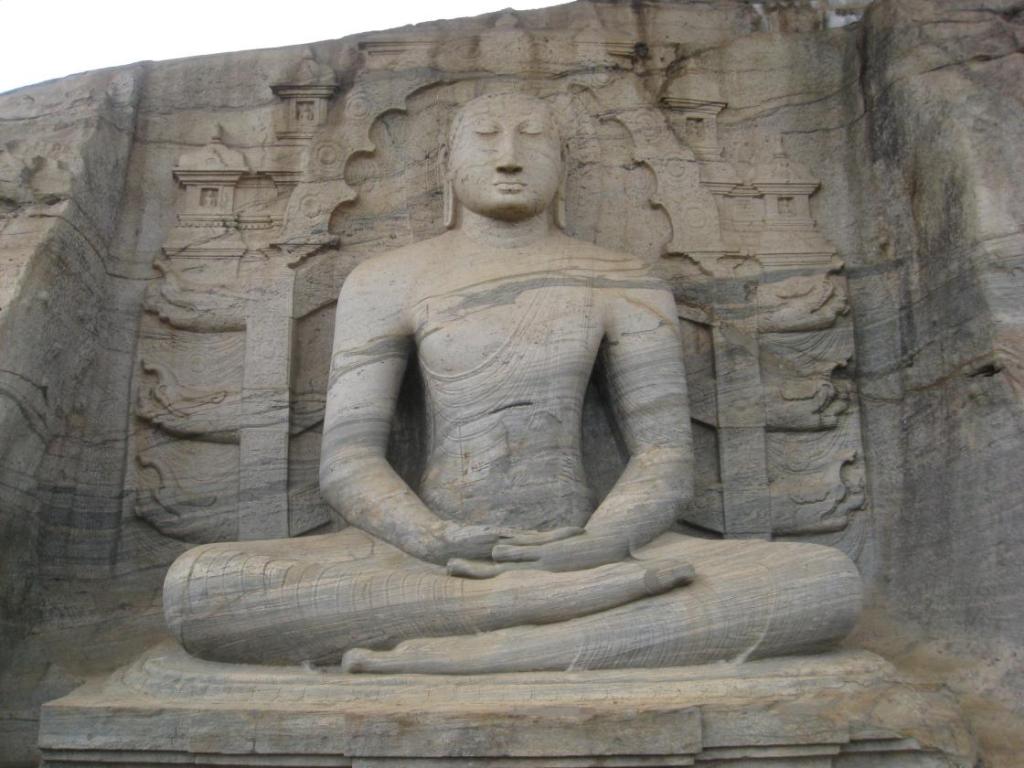
Polonnaruwa had already made an impression on me the day before, with its relatively small size, its lake, and the kindness of its people, but the Archaeological Park is particularly impressive. There are few tourists about, outstanding monuments, and trees everywhere. The archaeological remains are surrounded by a forest astir with small animals, including monitor lizards which we catch a glimpse of. The group of Buddha statues carved into the granite of Gal Vihara and the circular structure of the Vatadage are both particularly impressive. With nobody around when we arrive at Gal Vihara, the place is even more evocative. There is only us, a couple of custodians, and the four statues of the Enlightened One under the drizzle: these include a Buddha sitting in meditation, a standing Buddha seven metres high (which, according to some, may be Ananda, Buddha’s cousin and one of his principal disciples), and a reclining Buddha 14 metres long. In the so-called Quadrangle, on the other hand, where the Vatadage is located together with other archaeological remains, we run into other tourists, including a large group of Germans who have arrived by bus (and, after a while, leave en masse). The Vatadage, now missing its roof, has four Buddhas placed before the four entrances facing the four cardinal points. At its centre is the small dagoba; and stone guardians at the base of the four staircases, with big stone crescent-shaped ‘doormats’, the so-called moonstones with carvings of elephants and birds.
Ending our tour at about two that afternoon, we walk back to the town centre, to the restaurant where we had had our breakfast and whose owner had lent an umbrella to Renauld. Géraldine’s umbrella, likewise, had been lent to her by our tuk-tuk driver.
After lunch, we are told that elephants have been sighted on the opposite shore of the lake. What news! Wild elephants! We immediately start looking for our tuk-tuk driver from that morning, to ask him to take us to the nearest shore of the lake, from where we should be able to spot these elephants. At first, we see nothing. But then, moving aside a little… there they are. They are quite far, on the opposite shore, and at that distance they look tiny, but we can now see them distinctly: two elephants drinking from the lake. And then Renauld points to a spot further down the shore, where there are still more elephants: a herd of five or six heads. I don’t think I’ve ever been in a country where so many wild animals could be seen around. Besides, there are dogs and monkeys everywhere, in the countryside as well as in the towns I have visited.
We return to our guesthouse to rest a little (with or without the rain, the heat and humidity enforce these breaks as one cannot stay out for too long). Then, at four that afternoon, we head for the Archaeological Museum before it closes. In the evening Renauld, Géraldine and I have dinner together again in ‘our’ restaurant, where I try hoppers for the first time, a kind of crunchy bowl-shaped roti with a filling of meat, vegetables and a fried egg. Delicious.
The following morning, I have breakfast in the guesthouse and then say goodbye to my French friends, who will travel on to Sigiriya, an ancient stronghold atop a monolithic rock formation that I will have to miss out on (they have a whole month at their disposal to romp about the island). At ten o’clock my coach is leaving for Colombo, from where I intend to travel on to the coastal town of Negombo, which promises to be more relaxing than the capital and, more importantly, is nearer the airport, from where my flight for Kuala Lumpur leaves the following day.
The journey from Polonnaruwa is long and tiring, but it allows me the joys of the landscape and, even more, the opportunity to witness an extraordinary sight: shortly after leaving the town behind us, the air fills with butterflies. Thousands, what feels like millions, of butterflies fluttering everywhere, along the roads, the fields, and the forest on either side of the road. It’s a fabulous sight. On and on with no breaks, kilometre after kilometre, for about an entire hour and a half! It may be normal for the other passengers, but I am dumbfounded. Every now and again, people at the edges of the road wave the coach down in order to jump on it while it’s still moving. Once again, the driving is rather laid-back, but as long as the roads are narrow there’s a limit to the speed one can go at. It is only later, about five and a half hours after our departure, as we get closer to Colombo and the lanes increase to two or three, that the driving starts to resemble an out-and-out race, with strong suicidal– homicidal tendencies. In fact, through the last half-hour stretch of the journey I am so scared that I nearly wet myself – we zigzag at full throttle in the middle of the traffic, dodging cars, tuk-tuks, bicycles and pedestrians, while our driver honks nonstop all the while.
We finally arrive at Saunders Pl. bus station in Colombo at around four that afternoon, miraculously unhurt. Then, thanks to the kindness of a helpful stranger who sees the bus to Negombo waiting at a traffic light and stops it for me to get on, I don’t have to wait long for another bus. It’s another hour and a half to my final destination, with a driver who seems even wilder than the previous one, if at all such a thing were possible.
I spend my last evening in a comfortable hotel next to the beach, walking around and enjoying one last rice and curry. The following morning, a tuk-tuk takes me to the airport where I had arrived ten days earlier, the end of another interesting journey in this amazing continent.
About the Writer :
Paolo Coluzzi was an Associate Professor at the University of Malaya, KL. At present, he is teaching Italian and Tai Chi in Granada, Spain, where he moved at the end of 2024. He first became interested in Buddhism at the age of 17. It is a fascination that has deepened over the years, thanks to personal practice and contact with the many monks and Dhamma experts he has encountered during his long stay in Asia.

