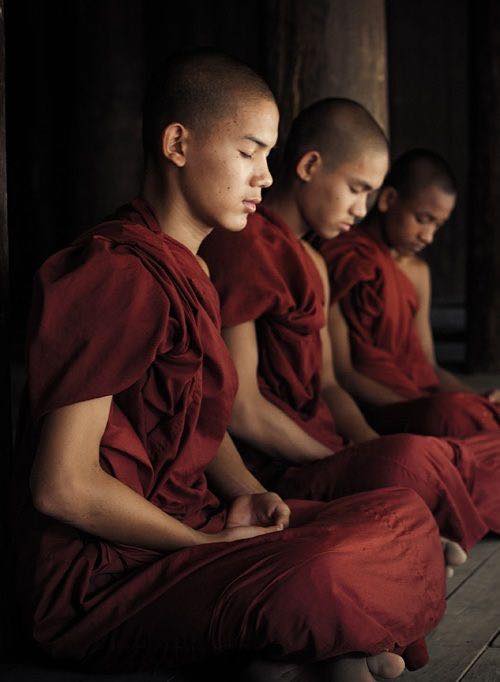
Vassana period
Vassana or Rains Retreat is the time frame or the period where the Buddhist monks remain indoors or in their monasteries for three months, commencing from the Esala Poya or July Full Moon Day. During the ‘Vassana’ period, Bhikkhus should stay indoors and perform religious activities such as conducting Dhamma sermons and meditation.
During the Buddha’s Time……
There were nearly 100 religions in India. Among them were Brahminism, Jainism, Achelaka, Paribrajaka, Thapasa, Jatila and Nigantha. The monks of these religions stayed indoors from July to October due to heavy rains. They believed that the rainy period belonged to worms and plants. They thought that if they walked, the worms and plants would die. The Buddha too set an example by asking Bhikkhus to stay indoors during the ‘Vassana’ season. Religious activities conducted during the ‘Vassana’ season help to promote unity between Bhikkhus and laymen.
Once thirty forest-dwelling monks wished to spend the rainy season with the Buddha, and they traveled together to where he would be staying. Unfortunately, the walk took longer than they anticipated, and the monsoons began before they had reached the Buddha’s summer dwelling. The thirty monks were disappointed but made the best of it. They found a place to stay together, and they meditated and studied together. And after three months, when the monsoon season ended, they hurried to find the Buddha.
But the roads were thick with mud, and rain still drizzled from the clouds and dripped from trees, and by the time they reached the Buddha their robes were muddy and drenched. They sat some distance from the Buddha, uncomfortable and probably embarrassed to be wearing such wet, dirty robes in the presence of their revered teacher. But the Buddha greeted them warmly and asked how their retreat had gone. Had they lived together harmoniously? Had they had enough food? Yes, they said.
At this point, it must be explained that it wasn’t easy for a monk to get new robes. Under the rules of the Vinaya, monks could not buy cloth, or ask someone for cloth, or borrow robes from another monk.
Buddhist monks’ and nuns’ robes were to be made from “pure cloth,” meaning cloth no one else wanted. So, monks and nuns scavenged in rubbish heaps looking for discarded cloth that had been scorched by fire, stained with blood, or even used as a shroud before cremation. The cloth would be boiled with vegetable matter such as bark, leaves, flowers, and spices, which usually gave the cloth an orange color (hence the name “saffron robe”). Monks sewed the bits of cloth together to make their own robes.
On top of that, the monastics were allowed to possess only the robes they wore, and they needed permission to take the time to scavenge for cloth. They were not allowed to keep the leftover cloth for their own future use.
So our muddy forest-dwelling monks resigned themselves to wearing moldy, muddy robes for their foreseeable futures.
The Buddha initiates Kathina…..
The Buddha perceived the sincere dedication of the forest-dwelling monks and felt compassion for them. A layperson had just given him a donation of cloth, and he gave this cloth to the monks to make a new robe for one among them. He also temporarily suspended some of the rules for all disciples who completed the Vas retreat. For example, they were given more free time to see their families.
The Buddha also established a procedure for giving and receiving cloth to make robes.
In the month following the end of Vassana, gifts of cloth may be given to the Sangha or community of monastics, but not to individual monks or nuns. Usually, two monks are designated to accept cloth for the entire Sangha. The cloth must be given freely and spontaneously; monastics may not ask for cloth or even hint that they could use some.
“In those days, making a robe required spreading the cloth on a frame called a “kathina,” The word literally means “hard,” and it also connotes stability and durability. So, Kathina is not just about cloth; it is also about firm commitment to monastic life.”
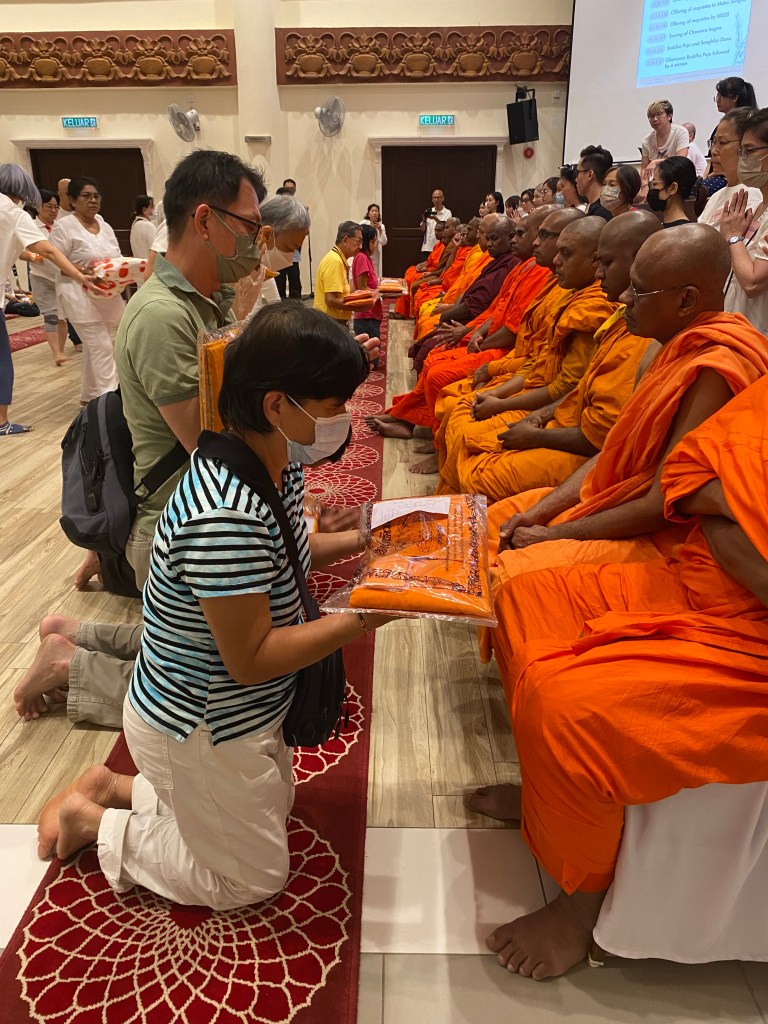
Kathina Season
The ‘Vassana’ Season ends with the Vap Poya or October Full Moon followed by the offering of the Kathina robes or Kathina Cîvara Ceremony. It marks the offering of Kathina robes to Bhikkhus who observed Vassana season. ‘Kathina’ season or ‘Cîvara Masaya’ lasts for one month beginning with the October Full Moon Day to November Full Moon Day.
This is the pinnacle of meritorious conduct of the season. Its importance lies when one considers the merit gained is said to be the foremost meritorious act one could do.
“Buddhists believe that through offering of “Kathina Cîvara”, one accrues the highest merit. Offering of a “Kathina Cîvara” is considered as a meritorious deed of a life time. It is believed that the merit gained is solid like a rock, and it cannot be erased easily and stands good throughout one’s samsara”.
The offering of a Kathina Robe also signifies the perpetuation or continuation of the Order of the Maha Sangha.
The ‘Kathina Cîvara’ or robes are bought by the laity and presented to the temple during the ‘Kathina Pinkama’ or Kathina Ceremony day. Before giving the ‘Kathina Cîvara’ to the temple, devotees carry it in a procession.
In Sri Lanka there will be colourful processions in many parts of the island in the early morning during the month where the Kathina Robe will be taken to their respective temples. In Myanmar, there are grand celebrations and is considered a national event. In Thailand, there are processions with musical instruments, dancers and marchers in traditional costumes.
It should be mentioned here that the “Kathina Cîvara”, or “Kathina Robe” is offered to the Maha Sangha as a whole who in turn, in accordance with the Vinaya rules, offers it by unanimous decision, to a deserving or virtuous (“silvath”) Bhikkhu, who during the entire Vassana season had observed his vows with piety at the Temple .
“The above article has been adapted and edited from 2 separate articles from the Vesak Lipi magazine and an independent website The Buddha Dhamma” – BMV Digest Editor
 BMV Digest