
The theme is to pay tribute to the 80 Maha Arahants and the 13 Maha Theri Arahants who had by their efforts won emancipation of a rare distinction. They belonged to the innermost circles in the life of the Gautama Buddha. The Buddha and the Maha Arahants were together most of the time.
No 77. Gaya Kassapa Thera –
He Followed his Brother’s Example
Gayā Kassapa was the youngest of the three Kassapa brothers. The eldest was Uruvelā and the other was Nadī – each with a following of 500 and 300 respectively. They were Brahman ascetics with matted hair (Jatilas), worshipping fire and practiced severe austerities. Uruvelā Kassapa was their chief. Gayā Kassapa had a following of 200. He too practiced the ritual fire-worship like his brothers and traditional water-cleansing rites to wash away sins.
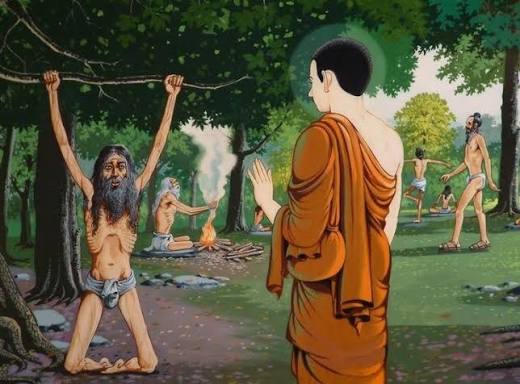
With their followers, the Kassapa brothers lived on the banks of the Neranjana river in ancient Magadha (near modern-day Bihar) in the Gayasisa region.
The Buddha and the Conversion of Uruvelā Kassapa
The Buddha on His journey from Baranasi, arrived at nearby Uruvelā. He knew of the three ascetic Kassapa brothers who lived in the Uruvela forest. The Buddha went to the hermitage of Uruvelā Kassapa and made a request thus: “If it is not too much of a burden to you, O Kassapa, I would like to stay at your place for one night.” “It is no burden for me,” replied Uruvelā Kassapa. The Blessed One seeing that the brothers practiced severe austerities and worshipped fire, preached a sermon on fire and said “Everything, O Jatilas, is burning. The eye is burning, all the senses are burning, thoughts are burning. They are burning with the fire of lust. There is anger, there is ignorance, there is hatred, and as long as the fire finds inflammable things upon which it can feed, so long will it burn, and there will be birth and death, decay, grief, lamentation, suffering, despair, and sorrow. Considering this, a disciple of the Dharma will see the four noble truths and walk in the eightfold path of holiness. He will become wary of his eye, wary of all his senses, wary of his thoughts. He will divest himself of passion and become free. He will be delivered from selfishness and attain the blessed state of Nirvana.” And Uruvelā Kassapa and the Jatilas at Uruvela rejoiced and took refuge in the Buddha, the Dharma, and the Sangha.
Gayā-Kassapa and His Disciples became Bhikkhus
When Gayā Kassapa, who lived down the river, saw the requisites of hermits set adrift by Uruvelā Kassapa and his five hundred disciples and by Nadī Kassapa and his three hundred disciples, he thought: “I hope no harm has befallen my brothers.” He went himself with (the rest of) his two hundred disciples to where Uruvelā Kassapa was dwelling. Approaching his eldest brother, he asked: “O Big Brother Kassapa, is this state of a bhikkhu much noble and praiseworthy?”
On being replied by Uruvelā Kassapa: “Indeed, brother, this state of a bhikkhu is much noble and praiseworthy,” Gayā Kassapa and his two hundred disciples, as previously done by Uruvelā-Kassapa and Nadi Kassapa and their followers, took their hermit’s requisites and paraphernalia of fire sacrifice, and set them adrift in the current of river Nerañjarā. Then they went to the Buddha and prostrating themselves with their heads touching the feet of the Blessed One, made the request: “Glorious Buddha, may we receive admission to the Order and become bhikkhus in your presence.”
Thereupon, the Blessed One said: “Etha bhikkhave, etc.” meaning: “Come, monks. Receive admission and ordination you have asked for. The Dhamma has been well taught by me. Strive to undergo noble trainings in its three higher aspects, so as to bring about the end of the round of suffering.” Instantly, with the call of ‘Etha bhikkhave’ by the Buddha who stretched out His right hand, Gayā Kassapa and his two hundred hermits turned into full-fledged bhikkhus, paying homage to the Buddha with due respect.
The Buddha’s Delivery of The Ādittapariyāya Sutta.
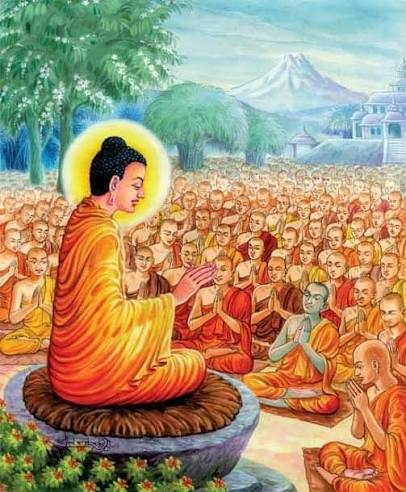
After staying at Uruvelā for as long as He wished to liberate the ascetic (Jatila) brothers and their one thousand followers, the Buddha set out for Gayā. The Buddha took His seat on a stone slab in front of the thousand bhikkhus.
Having taken His seat, the Buddha considered: “What kind of Discourse will be appropriate for these one thousand bhikkhus?” and decided thus: “These people had worshipped fires every day and every night, if I were to teach them the Ādittapariyāya Sutta (SN 35.28) describing the continuous burning of the twelve sense-bases (āyatana), by the eleven fires, they could attain the arahatta-phala.”
Having so decided, the Buddha taught the Ādittapariyāya Sutta (SN 35.38) which describes in a detail manner how the six doors of senses, the six objects of senses, the six forms of consciousness, the six forms of contact, the eighteen kinds of feeling, arising through contact (phassa paccaya vedanā), are burning with the fire of lust (rāga), the fire of hate (dosa), the fire of delusion (moha), the fires of birth, ageing and death, sorrow, lamentation, pain, grief and despair.
While the Discourse was thus taught by the Buddha, the one thousand bhikkhus attained the Knowledge of the Four Paths in successive order and became Arahants in whom āsavas were extinguished. Therefore, the minds of the one thousand bhikkhus were completely released from āsavas that had become extinguished with no chance of reappearance as they (the bhikkhus) had absolutely eradicated grasping through craving (taṇhā) and wrong view (diṭṭhi) of anything as ‘This I am, this is mine.’ They were completely emancipated from āsavas, attaining cessation through not arising.
Gaya Kassapa’s Reflection from the Theragatha
After becoming established in Arahantship, Gaya Kassapa reflected upon his own proper performance (paṭipattiṃ) and spoke these five stanzas in order to reveal his Arahantship.
[345] Pāto majjhantikaɱ sāyaɱ tikkhattuɱ divasassahaɱ,
Otariɱ udakaɱ so’haɱ gayāya gayaphagguyā.
Previously, three times a day—in the morning, at midday and in the evening—I went down into the water from the bank of the Gaya Elgu River at Gaya.
[346] Yaɱ mayā pakataɱ pāpaɱ pubbe aññāsu jātisu,
Taɱ dānīdha pavāhemi evaɱdiṭṭhi pure ahuɱ.
Formerly, I held the view that whatever evil was done by me in previous births can now be washed away here.
[347] Sutvā subhāsitaɱ vācaɱ dhammatthasahitaɱ padaɱ,
Tathaɱ yāthāvataɱ atthaɱ yoniso paccavekkhisaɱ.
Later, I got to hear the meaningful and well spoken words of the Buddha. I reflected wisely on that meaningful, true and practical Dhamma.
[348] Ninhātasabbapāpomhi nimmalo payato suci,
Suddho suddhassa dāyādo putto buddhassa oraso.
I washed away all evil with the water of Dhamma. I scrubbed away the stain of ignorance and became purified and clean. I received the pure inheritance of the pure Buddha. I became a son who was born from the heart of the Buddha.
[349] Ogayhaṭṭhaŋgikaɱ sotaɱ sabbapāpaɱ pavāhayiɱ,
Tisso vijjā ajjhagamiɱ kataɱ buddhassa sāsanan’ ti.
Having plunged into the stream of the Noble Eightfold Path, I have washed all my evil away. I have attained the Triple Knowledge. The Buddha’s path has been fully followed by me.

