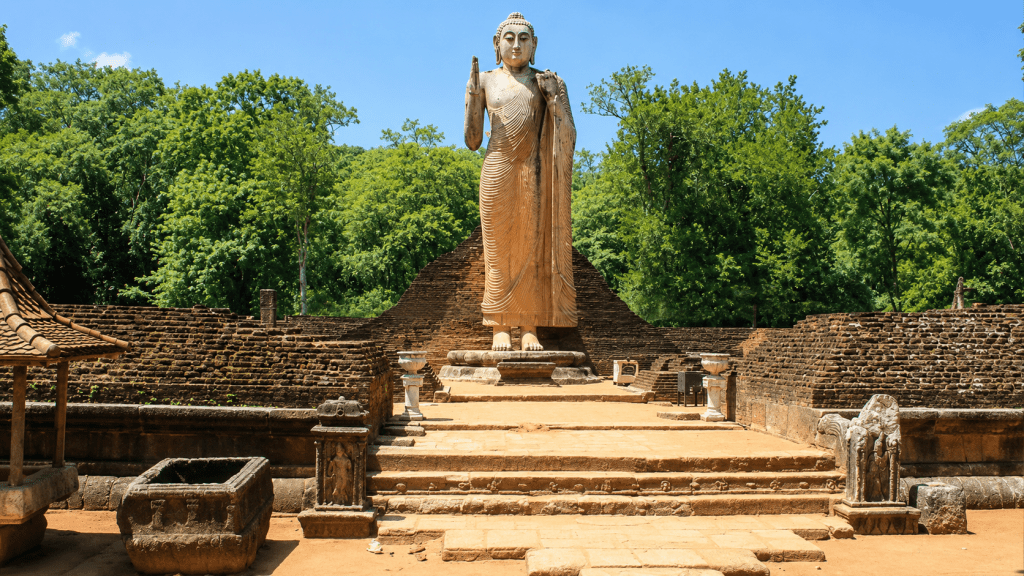
The Maligawila Buddha statue is a standing statue of the Buddha in Sri Lanka, carved from a large limestone rock during the 7th century by King Agrabodhi IV. It is the tallest free-standing ancient Buddha statue in the country located near the village of Maligawila in the Moneragala District of the Uva Province in Sri Lanka.
It is believed that Maligawila is the ancient Kanagama where, according to Mahavamsa, a large image house was built by King Aggabodhi IV [(667-683 A.D.) It is also mentioned that the king built a 15 feet high Bodhisattva Maitreya together with a large Buddha image and donated it to the Ariyakari Viharaya. The Dambegoda Bodhisattva Statue which is located near Maligawila is thought to be that Bodhisattva image built by the King. In ancient times Maligawila and Dambegoda remained as one monastery site
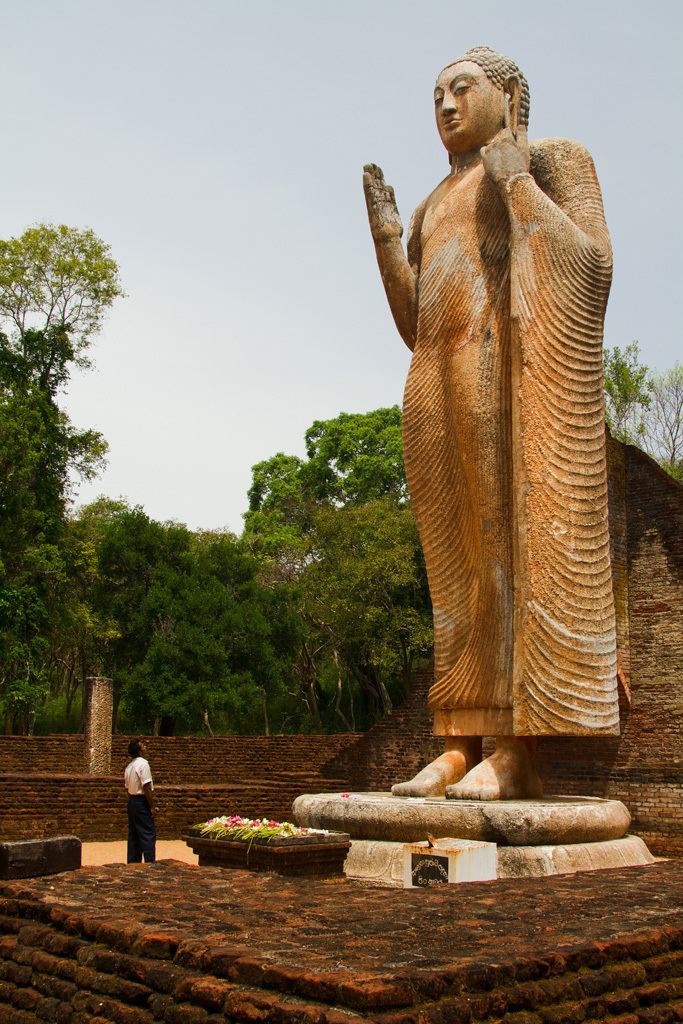
By the time the standing Buddha statue was found in 1951, it had been broken into several pieces. The statue is carved from a single large crystalline limestone rock, it stands at 41 feet and 10 inches high (including the pedestal). Along with the Buddha statues of Avukana and Buduruwagala, the Maligawila Buddha statue is considered one of the finest examples of standing Buddha images in ancient Sri Lanka. It closely resembles the Avukana statue and depicts the Asisa Mudra, a variation of the Abhaya Mudra, where the Buddha clutches the robe at the left shoulder while the right hand is raised to the right shoulder. The face is round and it is adorned with half-closed eyes and long ears (Lambakarna). The robe is closely touching the Buddha’s body but leaves the right shoulder bare. The ripples of the robe are shown by regular concave ridges.
Ruins found around the statue indicate the existence of an image house measuring approximately 80 feet in length and breadth, with walls about 4 feet thick and a height estimated at around 65 feet. The statue, which had fallen from its pedestal and lay in pieces, was discovered in 1951. Before this, it had been damaged by vandals using dynamite in 1948. An attempt to raise the statue in 1974 was unsuccessful. However, another attempt in 1991, under President Ranasinghe Premadasa, succeeded. Several broken sections, including the right hand, face, and feet, had been damaged and were repaired before the statue was reconstructed and re-erected. The restoration has been described as a ‘highly significant task’ carried out under Premadasa’s direction. Today, the Maligawila Buddha statue attracts a large number of pilgrims each year.
Source : https://www.lakpura.com/fr/pages/maligawila-buddha-statue and https://www.lankapradeepa.com/2021/02/maligawila-buddha-statue.html
 BMV Digest